
Industrial assets do not fail at random.
Bearings degrade.
Seals wear.
Compressors drift.
Rotating equipment weakens under process stress.
Most maintenance strategies react to alarms or fixed service intervals. By the time a threshold is breached, failure may already be imminent.
VROC’s Time to Failure Prediction solution uses real-time operational data to estimate Remaining Useful Life (RUL) and predict when equipment is likely to fail — enabling maintenance teams to act early, confidently, and strategically.
Traditional maintenance approaches rely on:
Fixed service schedules
Static alarm thresholds
Manual inspection
Post-failure diagnosis
These methods either intervene too late — or too often.
Time to Failure Prediction replaces guesswork with data-driven foresight by identifying subtle degradation patterns linked to real operating conditions.
Instead of asking, “Has something failed?”
VROC answers, “How long do we have before it fails?”
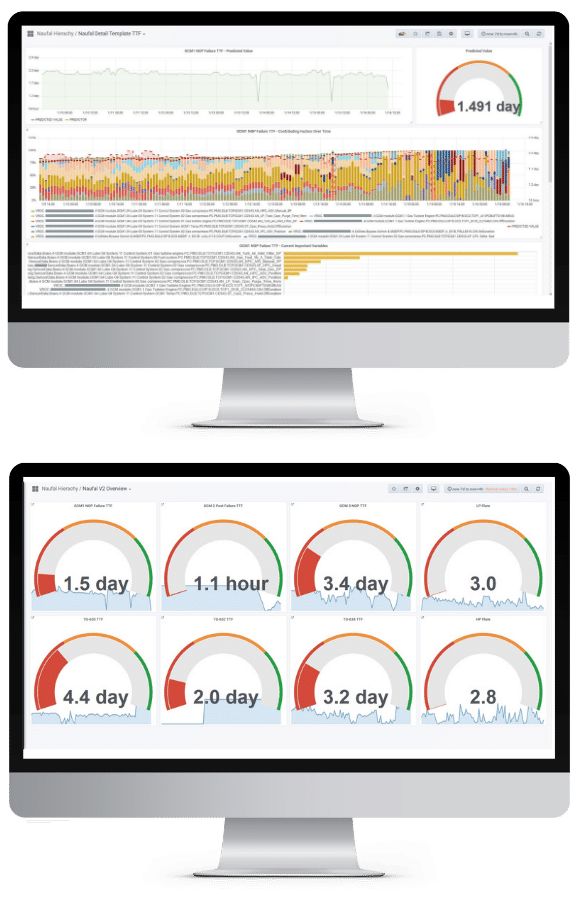
Understand how much operational life remains before critical failure.
* Continuous health scoring
* Dynamic degradation modeling
* Asset-specific failure forecasting
* Maintenance prioritization by risk
Maintenance becomes planned — not reactive.
Process conditions directly impact mechanical wear.
VROC identifies:
* Load-induced stress patterns
* Temperature-related degradation
* Vibration behavior changes
* Performance drift tied to process variability
This is particularly valuable for aging assets operating under fluctuating demand.
Not all assets carry equal risk.
Time to Failure Prediction enables:
* Failure impact assessment
* Risk-based work order prioritization
* Improved spare parts planning
* Reduced unnecessary maintenance
Resources are directed where they create the most value.
Unplanned outages are expensive and disruptive.
By forecasting failure windows, teams can:
* Align maintenance with scheduled shutdowns
* Reduce emergency interventions
* Minimize production loss
* Protect safety and compliance
Prediction reduces operational disruption.
Accuracy alone is not enough.
Engineers must understand why a prediction is made.
VROC provides:
Explainable model outputs
Visibility into contributing variables
KPI-to-sensor traceability
Continuous model performance monitoring
Predictions support decisions — they do not replace engineering judgment.
Time to Failure Prediction builds on:
Because degradation begins as subtle deviation, early detection strengthens prediction accuracy.
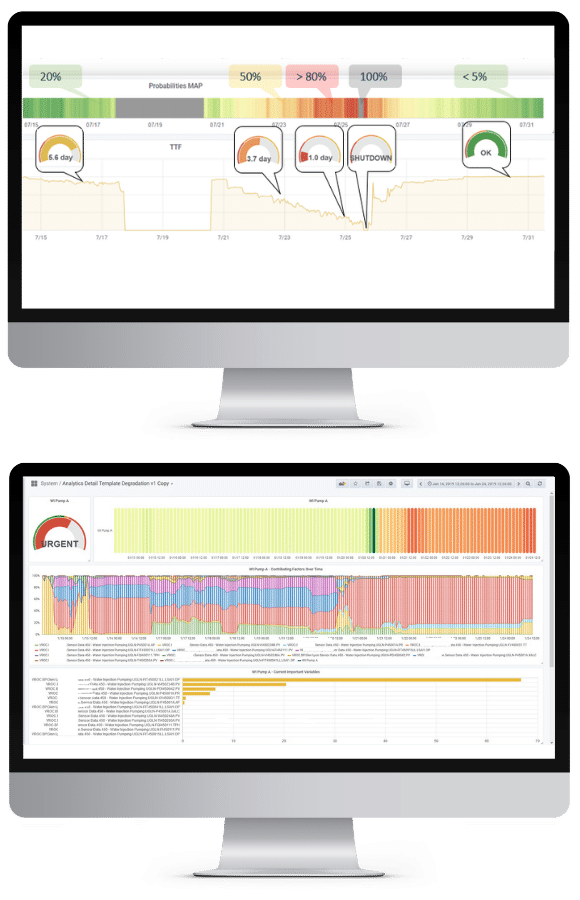
Bearing degradation
Pump and compressor wear
Valve and actuator deterioration
Process-induced mechanical stress
Unplanned failure results in:
Lost production
Emergency maintenance costs
Safety exposure
Collateral equipment damage
Reduced asset life
Predictive foresight enables:
Higher availability
Lower maintenance cost
Safer operations
Better capital planning
Extended asset lifecycle
Discover how VROC enables accurate, explainable time to failure prediction across critical industrial assets - explore Predictive Maintenance & Reliability
Gain real-time visibility, predict failure earlier, optimize performance, and take control of your operations with VROC’s integrated solutions.
Interested in a demo of one of our data solution products?
DataHUB4.0 is our enterprise data historian solution, OPUS is our Auto AI platform and OASIS is our remote control solution for Smart Cities and Facilities.
Book your demo with our team today!
The efficient deployment, continuous retraining of models with live data and monitoring of model accuracy falls under the categorisation called MLOps. As businesses have hundreds and even.
Learn more about DataHUB+, VROC's enterprise data historian and visualization platform. Complete the form to download the product sheet.
Interested in reading the technical case studies? Complete the form and our team will be in touch with you.
Subscribe to our newsletter for quarterly VROC updates and industry news.